

Title text:
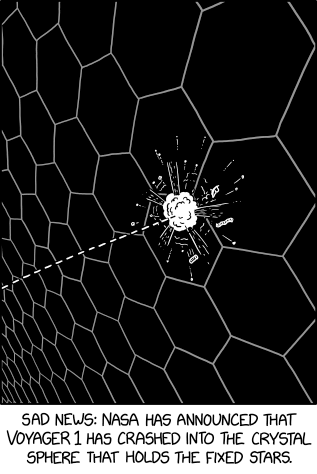
[Several months later] Actaully, it looks like what it hit a few months ago was just the START of the crystal sphere zone. New data confirms Voyager 1 has now struck the ACTUAL crystal sphere.
Transcript:
Transcript will show once it’s been added to explainxkcd.com
Source: https://xkcd.com/3326/
The medium here is the solar wind plasma as opposed to Earth’s atmosphere, but the waves are still acoustic, so the term “supersonic” is used widely in this sort of magnetohydrodynamic space physics. At 300-400 km/s, or often even faster, the outward-flowing solar plasma outruns the waves generated within the plasma itself (as it interacts with the weak magnetic fields). So yes, your assumption was correct.
Thanks, that helps clear it up.
Though I have to admit, I’m mildly surprised the plasma is dense enough to interact with itself in waves at all. You mentioned “weak magnetic fields;” is that qualitatively different from molecules bumping into each other in a more familiar fluid of Earth-like density? (Kinda like how a Newton’s cradle is different from a stack of floating ring-shaped magnets on a stick?)
I know what you mean about the density seeming too low, I’d often do a double-take as well when I was introduced to plasma physics. I can’t claim to understand all the bulk behaviour of the plasma out there, but it is certainly a collisionless fluid, so nothing like what we see in a planetary atmosphere, not even the outermost layers. I recall reading that individual particles have a mean free path of ~1 AU, so they can literally go from the Sun to the Earth without colliding. The particles are spiraling along the magnetic field lines anyway, though, and the lines extend all the way back to the Sun whence they originate, so visualizing them is very necessary to understand this stuff. The field strength may be small, but we’re talking individual electrons and ions here.
As for wave interactions, the thing is that they are being generated upstream and downstream of any individual particle, so I find it easier to imagine the fluid is being “bathed” pretty widely, so to speak. And that’s before you consider plasma waves… yeah, maybe I’m not cut out to be a heliophysicist.